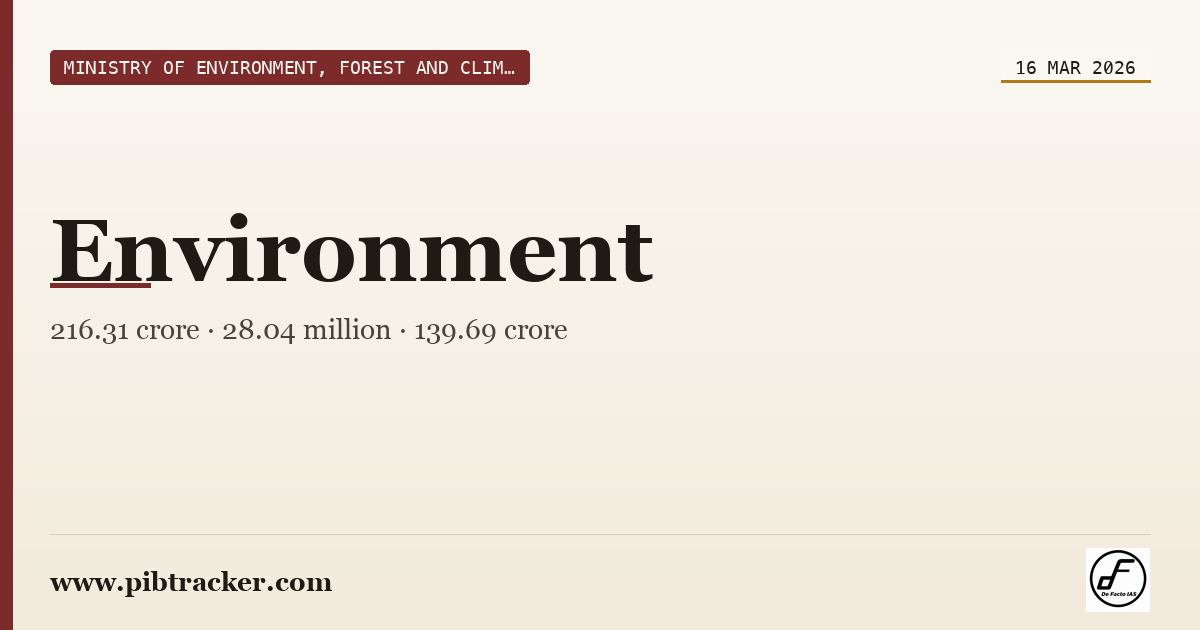
Posted On: 16 MAR 2026 1:47PM by PIB Delhi The Ministry of Environment, Forest and Climate Change (MoEFCC), in collaboration with the National Biodiversity Authority (NBA), has submitted India’s First National Report (NR1) on the implementation of the Nagoya Protocol on Access to Genetic Resources and the Fair and Equitable Sharing of Benefits Arising from their Utilization (ABS) to the Secretariat of the Convention on Biological Diversity (CBD) on 27th February 2026, in accordance with Article 29 of the Protocol on Monitoring and Reporting. The report covers the period from 1 November 2017 to 31 December 2025 and highlights India’s progress in implementing the Nagoya Protocol while contributing to Target 13 of India’s updated National Biodiversity Strategy and Action Plan (NBSAP). India had earlier submitted its Interim National Report in November 2017. India’s ABS framework operates under the Biological Diversity Act, 2002, supported by the Biological Diversity Rules, 2024 and the ABS Regulations, 2025, through a three-tier institutional structure comprising the National Biodiversity Authority, State Biodiversity Boards/Union Territory Biodiversity Councils, and Biodiversity Management Committees (BMCs) at the local level. More than 2,76,653 BMCs have been established across the country, strengthening community participation in biodiversity governance and benefit-sharing mechanisms. During the reporting period (2017–2025), India issued 12,830 ABS approvals, including 5,913 approvals by the NBA for entities under Section 3(2) of the Biological Diversity Act covering research, bio-survey, commercial utilisation, transfer of research results, intellectual property rights and third-party transfers, and 6,917 approvals by SBBs/UTBCs for Section 7 entities for commercial utilisation of biological resources. India has also published 3,556 Internationally Recognised Certificates of Compliance (IRCCs) on the ABS Clearing-House, in accordance with Article 17 of the Nagoya Protocol, representing over 60% of the global total and demonstrating India’s leadership in transparency and compliance. Implementation of the ABS framework has generated significant benefits. During the reporting period, ₹216.31 crore (USD 28.04 million) was mobilised through NBA approvals, of which ₹139.69 crore (USD 16.83 million) has been disbursed to benefit claimers, including BMCs, local communities, farmers and traditional knowledge holders, supporting biodiversity conservation and livelihoods. In addition, ₹51.96 crore (USD 6.56 million) was generated through approvals granted by SBBs/UTBCs for commercial utilisation by Indian entities under Section 7 of the Act. Furthermore, 395 NBA approvals incorporated non-monetary benefits, including capacity building, training, technology transfer and collaborative research. In line with the Nagoya Protocol, India also monitors the utilisation of foreign-sourced biological resources and associated traditional knowledge and 41 declarations were received by NBA in Form 10 for use of foreign bioresources as required under Rules 18 of the BD rules, 2024 and Section 36A of the BD Act, 2002. India has also undertaken extensive awareness and capacity-building initiatives to strengthen ABS implementation. A total of 2,56,393 individuals were trained through 3,724 workshops and programmes, alongside over 600 capacity-building initiatives nationwide. With a strong legal framework, robust institutions and active community participation, India has emerged as a global leader in implementing the Nagoya Protocol. For more information on India’s First National Report to CBD on the implementation of Nagoya Protocol, visit the Access and Benefit-Sharing Clearing-House of the CBD: ( https://absch.cbd.int/en/countries/IN ). ***** VM/GS (Release ID: 2240577) Visitor Counter : 5168 Read this release in: Urdu , हिन्दी , Punjabi Ministry of Environment, Forest and Climate Change India Submits 1st National Report on Implementation of Nagoya Protocol on Access and Benefit Sharing to Convention on Biological Diversity Posted On: 16 MAR 2026 1:47PM by PIB Delhi The Ministry of Environment, Forest and Climate Change (MoEFCC), in collaboration with the National Biodiversity Authority (NBA), has submitted India’s First National Report (NR1) on the implementation of the Nagoya Protocol on Access to Genetic Resources and the Fair and Equitable Sharing of Benefits Arising from their Utilization (ABS) to the Secretariat of the Convention on Biological Diversity (CBD) on 27th February 2026, in accordance with Article 29 of the Protocol on Monitoring and Reporting. The report covers the period from 1 November 2017 to 31 December 2025 and highlights India’s progress in implementing the Nagoya Protocol while contributing to Target 13 of India’s updated National Biodiversity Strategy and Action Plan (NBSAP). India had earlier submitted its Interim National Report in November 2017. India’s ABS framework operates under the Biological Diversity Act, 2002, supported by the Biological Diversity Rules, 2024 and the ABS Regulations, 2025, through a three-tier institutional structure comprising the National Biodiversity Authority, State Biodiversity Boards/Union Territory Biodiversity Councils, and Biodiversity Management Committees (BMCs) at the local level. More than 2,76,653 BMCs have been established across the country, strengthening community participation in biodiversity governance and benefit-sharing mechanisms. During the reporting period (2017–2025), India issued 12,830 ABS approvals, including 5,913 approvals by the NBA for entities under Section 3(2) of the Biological Diversity Act covering research, bio-survey, commercial utilisation, transfer of research results, intellectual property rights and third-party transfers, and 6,917 approvals by SBBs/UTBCs for Section 7 entities for commercial utilisation of biological resources. India has also published 3,556 Internationally Recognised Certificates of Compliance (IRCCs) on the ABS Clearing-House, in accordance with Article 17 of the Nagoya Protocol, representing over 60% of the global total and demonstrating India’s leadership in transparency and compliance. Implementation of the ABS framework has generated significant benefits. During the reporting period, ₹216.31 crore (USD 28.04 million) was mobilised through NBA approvals, of which ₹139.69 crore (USD 16.83 million) has been disbursed to benefit claimers, including BMCs, local communities, farmers and traditional knowledge holders, supporting biodiversity conservation and livelihoods. In addition, ₹51.96 crore (USD 6.56 million) was generated through approvals granted by SBBs/UTBCs for commercial utilisation by Indian entities under Section 7 of the Act. Furthermore, 395 NBA approvals incorporated non-monetary benefits, including capacity building, training, technology transfer and collaborative research. In line with the Nagoya Protocol, India also monitors the utilisation of foreign-sourced biological resources and associated traditional knowledge and 41 declarations were received by NBA in Form 10 for use of foreign bioresources as required under Rules 18 of the BD rules, 2024 and Section 36A of the BD Act, 2002. India has also undertaken extensive awareness and capacity-building initiatives to strengthen ABS implementation. A total of 2,56,393 individuals were trained through 3,724 workshops and programmes, alongside over 600 capacity-building initiatives nationwide. With a strong legal framework, robust institutions and active community participation, India has emerged as a global leader in implementing the Nagoya Protocol. For more information on India’s First National Report to CBD on the implementation of Nagoya Protocol, visit the Access and Benefit-Sharing Clearing-House of the CBD: ( https://absch.cbd.int/en/countries/IN ). ***** VM/GS (Release ID: 2240577) <span style="font-family:Times New Roman,Times,serif"><span style="font-size:16px">The Ministry of Environment, Forest and Climate Change (MoEFCC), in collaboration with the National Biodiversity Authority (NBA), has submitted India’s First National Report (NR1) on the implementation of the Nagoya Protocol on Access to Genetic Resources and the Fair and Equitable Sharing of Benefits Arising from their Utilization (ABS) to the Secretariat of the Convention on Biological Diversity (CBD) on 27th February 2026, in accordance with Article 29 of the Protocol on Monitoring and Reporting.</span></span></p> <p dir="ltr" style="text-align:justify"><span style="font-family:Times New Roman,Times,serif"><span style="font-size:16px">The report covers the period from 1 November 2017 to 31 December 2025 and highlights India’s progress in implementing the Nagoya Protocol while contributing to Target 13 of India’s updated National Biodiversity Strategy and Action Plan (NBSAP). India had earlier submitted its Interim National Report in November 2017.</span></span></p> <p dir="ltr" style="text-align:justify"><span style="font-family:Times New Roman,Times,serif"><span style="font-size:16px">India’s ABS framework operates under the Biological Diversity Act, 2002, supported by the Biological Diversity Rules, 2024 and the ABS Regulations, 2025, through a three-tier institutional structure comprising the National Biodiversity Authority, State Biodiversity Boards/Union Territory Biodiversity Councils, and Biodiversity Management Committees (BMCs) at the local level. More than 2,76,653 BMCs have been established across the country, strengthening community participation in biodiversity governance and benefit-sharing mechanisms.</span></span></p> <p dir="ltr" style="text-align:justify"><span style="font-family:Times New Roman,Times,serif"><span style="font-size:16px">During the reporting period (2017–2025), India issued 12,830 ABS approvals, including 5,913 approvals by the NBA for entities under Section 3(2) of the Biological Diversity Act covering research, bio-survey, commercial utilisation, transfer of research results, intellectual property rights and third-party transfers, and 6,917 approvals by SBBs/UTBCs for Section 7 entities for commercial utilisation of biological resources. India has also published 3,556 Internationally Recognised Certificates of Compliance (IRCCs) on the ABS Clearing-House, in accordance with Article 17 of the Nagoya Protocol, representing over 60% of the global total and demonstrating India’s leadership in transparency and compliance.</span></span></p> <p dir="ltr" style="text-align:justify"><span style="font-family:Times New Roman,Times,serif"><span style="font-size:16px">Implementation of the ABS framework has generated significant benefits. During the reporting period, ₹216.31 crore (USD 28.04 million) was mobilised through NBA approvals, of which ₹139.69 crore (USD 16.83 million) has been disbursed to benefit claimers, including BMCs, local communities, farmers and traditional knowledge holders, supporting biodiversity conservation and livelihoods. In addition, ₹51.96 crore (USD 6.56 million) was generated through approvals granted by SBBs/UTBCs for commercial utilisation by Indian entities under Section 7 of the Act. Furthermore, 395 NBA approvals incorporated non-monetary benefits, including capacity building, training, technology transfer and collaborative research.</span></span></p> <p dir="ltr" style="text-align:justify"><span style="font-family:Times New Roman,Times,serif"><span style="font-size:16px">In line with the Nagoya Protocol, India also monitors the utilisation of foreign-sourced biological resources and associated traditional knowledge and 41 declarations were received by NBA in Form 10 for use of foreign bioresources as required under Rules 18 of the BD rules, 2024 and Section 36A of the BD Act, 2002. </span></span></p> <p dir="ltr" style="text-align:justify"><span style="font-family:Times New Roman,Times,serif"><span style="font-size:16px">India has also undertaken extensive awareness and capacity-building initiatives to strengthen ABS implementation. A total of 2,56,393 individuals were trained through 3,724 workshops and programmes, alongside over 600 capacity-building initiatives nationwide. </span></span></p> <p dir="ltr" style="text-align:justify"><span style="font-family:Times New Roman,Times,serif"><span style="font-size:16px">With a strong legal framework, robust institutions and active community participation, India has emerged as a global leader in implementing the Nagoya Protocol. </span></span></p> <p dir="ltr" style="text-align:justify"><span style="font-family:Times New Roman,Times,serif"><span style="font-size:16px">For more information on India’s First National Report to CBD on the implementation of Nagoya Protocol, visit the Access and Benefit-Sharing Clearing-House of the CBD: (<a href="https://absch.cbd.int/en/countries/IN" target="_blank">https://absch.cbd.int/en/countries/IN</a>).</span></span></p> <p dir="ltr" style="text-align:center"><span style="font-family:Times New Roman,Times,serif"><span style="font-size:16px">*****</span></span></p> <p dir="ltr" style="text-align:justify"><strong><span style="font-family:Times New Roman,Times,serif"><span style="font-size:16px">VM/GS</span></span></strong></p> " /> var mPlayer = document.getElementById("background_music"); var mPlayAction = document.getElementById("playbutton"); var isPlaying = false; function playAudio() { mPlayer.play(); isPlaying = true; document.getElementById('stopA').style.display = "block"; document.getElementById('playA').style.display = "none"; } function pauseAudio() { mPlayer.pause(); isPlaying = false; document.getElementById('playA').style.display = "block"; document.getElementById('stopA').style.display = "none"; } //function HandleAudio() { // if (isPlaying == true) { // //Playing already Pause it // pauseAudio(); // } else { // //Play the music // playAudio(); // } //} var synth = window.speechSynthesis; function CleanHtml(html) { html = html.replace(/ /gi, ''); return html; } function stripHtml(html) { let tmp = document.createElement("DIV"); tmp.innerHTML = CleanHtml(html); return tmp.textContent || tmp.innerText || ""; } $(document).ready(function () { //for responsive tables $("table").each(function () { if (!$(this).closest(".table-responsive").length) { $(this).wrap(" "); } }); var width = $(window).width(); if (width $(document).ready(function () { var width = $(window).width(); if (width @media print { .sticky-social, .sticky-social_mb, .pull-right, #printPDF { display: none !important; } } .f_vl { padding-right: 30px; font-size: 17px; cursor: pointer; } .log_oo { // width: 20%; display: flex; justify-content: space-between; } .log_oo img { width: 150px; /*width: 100%; height: auto;*/ } .sticky-social_mb { position: fixed; bottom: 0px; padding: 0px; margin: 0px; width: 100%; } .social_mb { list-style: none; display: flex; width: 100%; margin-bottom: -8px; } .social_mb a { padding: 8px 0px; font-size: 30px; transition: all 0.8s ease-in-out; width: 20% !important; text-align: center; } .section1 { position: relative; padding: 10px 0px; width: 100%; } .sticky-social { position: fixed; top: 20px; left: 0px; padding: 0px; margin: 0px; } .social { list-style: none; } .social a li { padding: 8px 12px; font-size: 25px; transition: all 0.8s ease-in-out; } .social a li:hover { margin-right: -30px; box-shadow: 2px 5px 10px grey; } .social a li:hover .fa { margin-left: 20px; } .fb_b { /* background-color: rgb(59, 89, 152);*/ background-color: rgba(65,103,178,255); } .twitter_r { /* background-color: rgb(29, 161, 242);*/ background-color: #000000; } .whatsapp_r { /* background-color: rgb(77, 194, 71);*/ background-color: rgba(13,191,67,255); } .fa-envelope_r { /* background-color: rgb(219, 68, 55);*/ background-color: #e2123d; } .fa-linkedin_r { background-color: rgb(0, 119, 181); } @media only screen and (max-device-width: 767px) { p span img { max-width: 90% !important; height: auto !important; } p img { max-width: 90% !important; height: auto !important; } h2 { font-size: 20px !important; font-weight: 600 !important; } h3 { font-size: 18px !important; font-weight: 600 !important; } } /* === Film Roll Badge Styling(IFFI2025 countdown) === */ .film-roll-badge { position: absolute; top:82%; right: 20px; width: 230px; height: 70px; background: repeating-linear-gradient( to right, #9a2375 0px, #9a2375 18px, #6e2b8b 18px, #6e2b8b 36px ); border-top: 8px solid #9a2375; border-bottom: 8px solid #9a2375; border-radius: 8px; overflow: hidden; box-shadow: 0 4px 12px rgba(0, 0, 0, 0.4); animation: moveFilm 8s linear infinite; z-index: 10; } /* film sprocket holes */ .film-roll-badge::before, .film-roll-badge::after { content: ""; position: absolute; width: 100%; height: 10px; background: repeating-linear-gradient( to right, #9a2375 0px, #9a2375 10px, #fff 10px, #fff 20px ); left: 0; z-index: 2; } .film-roll-badge::before { top: -4px; } .film-roll-badge::after { bottom: -4px; } .film-roll-inner { position: relative; height: 100%; display: flex; align-items: center; justify-content: center; animation: flicker 2s infinite ease-in-out; } .countdown-text { font-size: 1.3rem; font-weight: 700; color: #fff; text-shadow: 0 0 6px rgba(255, 255, 255, 0.4), 0 0 10px #000; white-space: nowrap; } /* === Animations === */ @keyframes moveFilm { 0% { background-position: 0 0; } 100% { background-position: 120px 0; } } @keyframes flicker { 0%, 100% { opacity: 1; } 50% { opacity: 0.9; } 25% { opacity: 0.95; } 75% { opacity: 0.85; } } /* === Responsive Adjustments === */ @media (max-width: 1500px) { .film-roll-badge { top: 68%; right: 18px; /* width: 220px; */ height: 65px; font-size: 0.85rem; } .press-section { margin-top: 35px; } } @media (max-width: 992px) { .film-roll-badge { top: 52%; right: 10px; width: 200px; height: 60px; } } @media (max-width: 768px) { .film-roll-badge { top: 56%; right: 10px; width: 124px; height: 55px; } .countdown-text { font-size: 0.9rem; } } @media (max-width: 576px) { .film-roll-badge { top: 59%; right: 5px; /* width: 160px; */ height: 50px; } .countdown-text { font-size: 0.85rem; } } const festivalStart = new Date("2025-11-20T00:00:00").getTime(); const festivalEnd = new Date("2025-11-28T23:59:59").getTime(); const countdownElement = document.getElementById("countdown"); const interval = setInterval(() => { const now = new Date().getTime(); // BEFORE FESTIVAL — show days + hours left if (now = festivalStart && now el.style.width = "350px"); clearInterval(interval); } }, 1000); //
India Submits 1st National Report on Implementation of Nagoya Protocol on Access and Benefit Sharing to Convention on Biological Diversity
Original PIB release
pib.gov.in · PRID 2240577
Open on PIB ↗
pib.gov.in · PRID 2240577